
Get Your Free Cash Offer Now!
Fill out this form to get your no-obligation all cash offer started!
Get Your Free Offer TODAY! (1)
Fill In This Form To Get Your No-Obligation All Cash Offer Started!
The Biggest Challenges When You Sell a House in Columbus Ohio With Code Violations
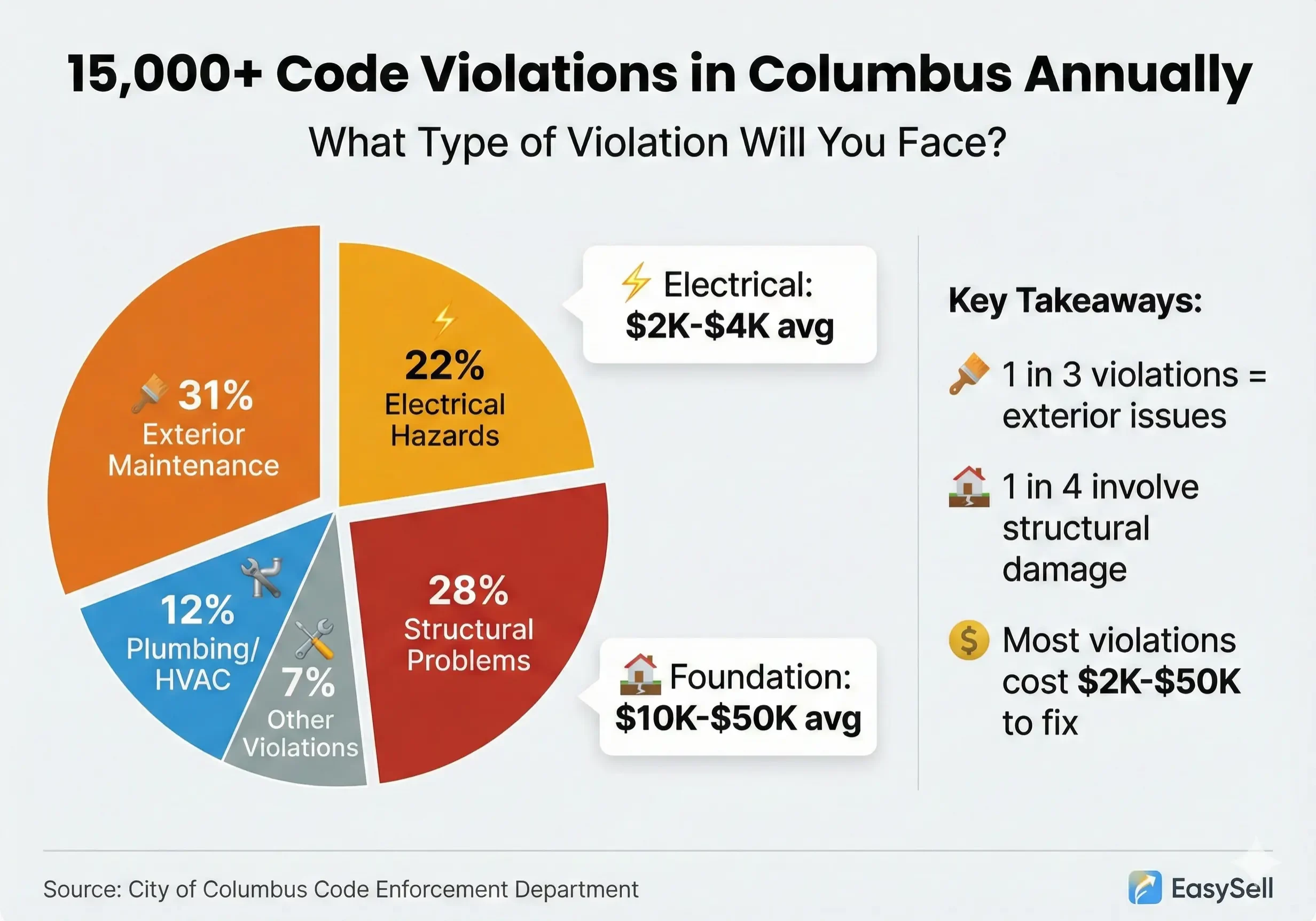
According to the City of Columbus Department of Code Enforcement, over 15,000 violation cases open annually. The breakdown tells you where problems cluster:
- 31% are exterior maintenance (peeling paint, broken siding, overgrown yards)
- 28% involve structural issues (foundation, roof, porches)
- 22% are electrical hazards (outdated panels, exposed wiring)
- 12% are plumbing or HVAC problems (no heat, leaking pipes)
- 7% are other violations (unpermitted work, health hazards)
Here's the financial reality: electrical panel replacement runs $2,000-$4,000 in Columbus. Foundation repairs? Anywhere from $10,000 to $50,000 depending on severity. When violations stack up, you're looking at repair bills that can exceed 20% of your home's value.
Meanwhile, Columbus assesses fines. Depending on the violation type, you could face $100-$250 per day until issues are corrected. Over 90 days—the typical timeline for a traditional sale—that's $9,000 to $22,500 in accumulating penalties before you even close.
Real Columbus Homeowner Stories

"The easiest sale I've ever made!"
"I had to sell my home quickly due to a job relocation, and EasySell made the entire process a breeze. I didn't have to deal with any repairs, and I had cash in hand in less than 2 weeks. Highly recommend them!"

Sarah P.
Columbus
"Fast, professional, and hassle-free"
"I was facing foreclosure and didn't know where to turn. EasySell gave me a fair cash offer and closed quickly, allowing me to avoid foreclosure. Their team was professional and understanding."

Mark D.
Upper Arlington
"Highly recommend for a fast sale"
"We needed to sell my dad's house after he passed away. EasySell took care of everything from start to finish. No cleaning, no repairs, just a fast and fair cash offer."

Jennifer M.
Hilliard
Want to Compare Your Options?
Get an as-is cash offer first. It gives you a real baseline so you can compare selling as-is versus listing or making repairs.
Fill In This Form To Get Your No-Obligation All Cash Offer Started!
Ohio Law on Selling Property With Code Violations
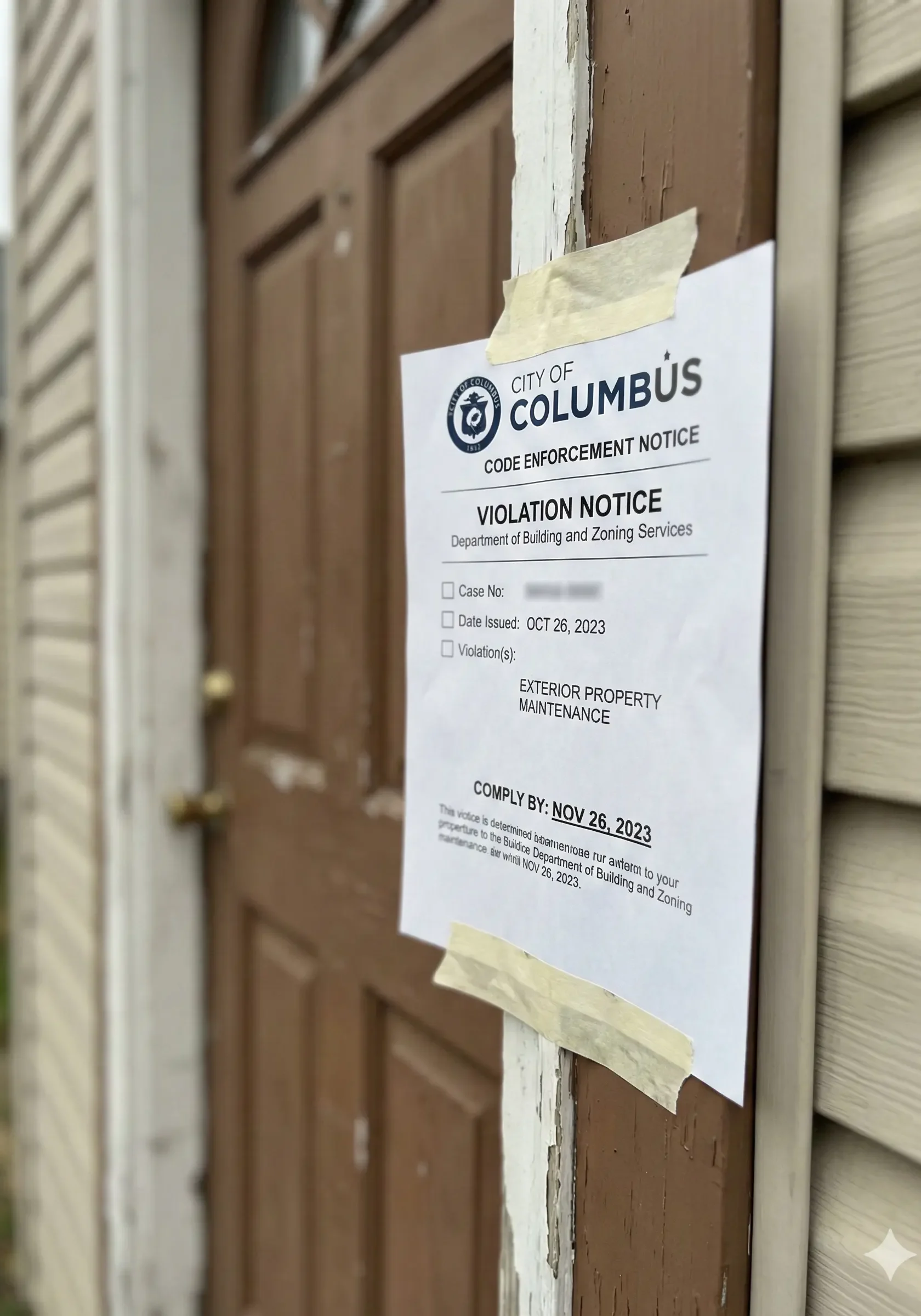
When you sell a house in Columbus Ohio with code violations, Ohio Revised Code §5301.253 controls what you must do. The statute is straightforward: if you've received written notice of building or housing code violations, you must give written notice to any prospective buyer before entering a sales contract.
What "Written Notice" Actually Means
You can't just mention violations verbally. Ohio requires documented disclosure—typically through the state's Residential Property Disclosure Form. This form asks specifically about code violations, citations, or required repairs. Your answers must be honest and complete.
Courts have ruled repeatedly that "as-is" contract language doesn't protect sellers from disclosure obligations. Even if your purchase agreement states the buyer accepts the property in current condition, you still must disclose known violations. Failure to disclose opens you to lawsuits for misrepresentation, rescission demands, or financial damages.
Columbus Won't Stop Your Sale—But Will Continue Enforcement
The City of Columbus has no ordinance preventing property transfers with open violations. The city wants compliance, not to block sales. When you sell, the new owner steps into responsibility for fixing issues.
What sellers often miss: you remain liable for violations and fines that occurred during your ownership. Selling doesn't erase past penalties or dismiss pending court cases against you. The enforcement action follows you personally for your period of ownership, while the repair obligation transfers with the property.
How to Handle the Transfer
Most successful sales with violations involve three steps: complete honest disclosure to buyers, resolve any recorded liens at closing (title companies will catch these), and communicate with Columbus Code Enforcement about the ownership transfer and timeline for repairs.
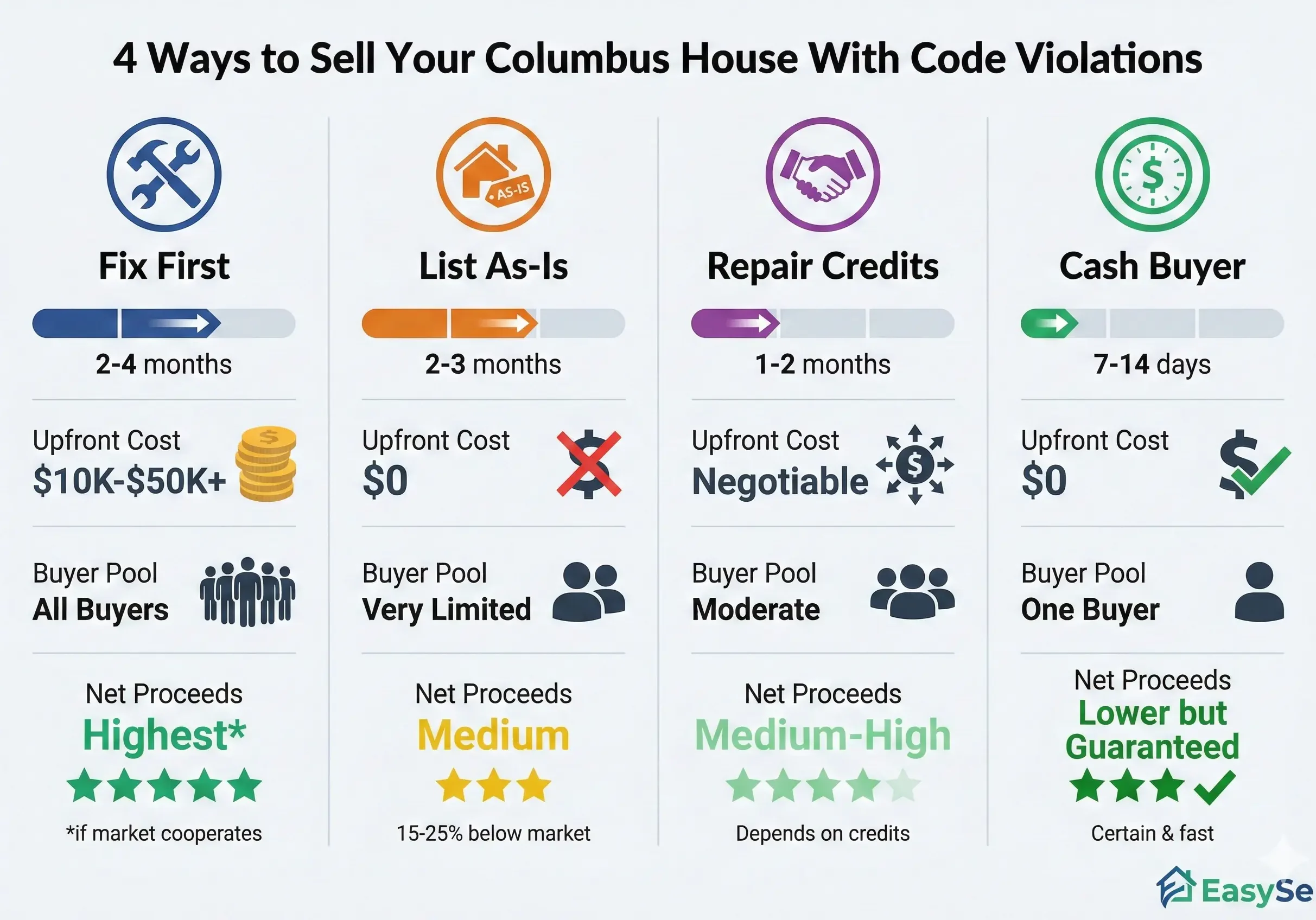
Four Ways to Sell a House in Columbus Ohio With Code Violations
Strategy 1: Repair Violations Before Listing
Fix everything, obtain permits, pass inspections, then list. This opens your buyer pool to everyone—FHA buyers, VA buyers, conventional financing. You'll likely get the highest price if the market cooperates.
The cost: $10,000-$50,000+ upfront, depending on violation severity. The timeline: 2-4 months between starting repairs and closing a sale. This path works if you have capital available and time isn't critical.
Strategy 2: List As-Is With Full Disclosure
Market the property in current condition with complete transparency about violations. Price aggressively to account for repairs buyers must handle. This approach mirrors selling other distressed properties in Columbus—you sacrifice some price for avoiding repair costs.
The reality: your buyer pool shrinks dramatically. Most financed buyers can't proceed when lenders see safety violations. FHA and VA loans have strict minimum property standards. You're primarily attracting cash buyers and investors. Expect 2-3 months on market and offers 15-25% below comparable violation-free homes.
Strategy 3: Negotiate Repair Credits or Escrow
Find a buyer, then structure the deal so they handle repairs post-closing. You might credit $5,000 at closing for electrical work, or escrow $10,000 until the buyer completes and verifies repairs. Lenders typically require holding 1.5-2x the estimated repair cost.
This middle-ground approach works with motivated buyers who want your specific property despite violations. Timeline runs 1-2 months. The challenge: many lenders won't allow credits for major safety issues—some violations must be fixed before loan funding.
Strategy 4: Sell to a Direct Cash Buyer
Skip repairs entirely and sell to an investor or cash buying company. No financing means no lender-required repairs. No appraisal means no value disputes over violations. Most cash transactions close in 7-14 days.
The trade-off: expect offers 20-30% below retail value. Cash buyers evaluate properties differently—they calculate repair costs, holding time, market risk, and their profit margin into the offer.
But run the numbers carefully. When you're facing daily fines, carrying costs, and months of uncertainty, a lower offer that closes in 10 days often nets you more than waiting 90 days for a higher price that might fall through. Especially if you're also dealing with financial pressure like pending foreclosure.
Why Cash Buyers Work for Properties With Violations
Traditional buyers need financing. Financing requires appraisals. Appraisers flag violations. Underwriters demand repairs. The deal stalls or dies.
Cash buyers eliminate that entire chain:
- No lender inspections or repair requirements
- No appraisal contingencies that could kill the deal
- No months of back-and-forth over who fixes what
- Certainty on closing date—often 7-14 days from offer acceptance
At EasySell Cash Homebuyers, we've purchased properties with active environmental court cases, accumulating daily fines, and violations exceeding $40,000 in estimated repairs. Our approach: evaluate the property, calculate actual repair costs, make a fair offer that accounts for the work needed, and close on your timeline.
What Happens to Violations After Closing
When title transfers, the buyer assumes the obligation to correct violations going forward. Outstanding liens typically get paid from your proceeds at closing—the title company will discover and require these to be satisfied for clear title.
Your liability for past non-compliance doesn't disappear. If Columbus already assessed fines or filed charges for your period of ownership, selling doesn't dismiss those. Ohio law explicitly states that transferring property "shall not be grounds for dismissal of charges against a previous owner."
The practical reality: communicate with Columbus Code Enforcement before closing. Many sellers successfully negotiate deadline extensions or work out payment plans for accumulated fines when they can show a buyer is committed to making repairs.
Questions to Ask Any Columbus Cash Buyer
Not all "we buy houses" companies operate the same way. Before accepting an offer, ask:
Are you the actual buyer, or will you assign this contract to someone else?
Can you provide proof of funds to close?
Which title company handles your closings?
What's your experience with properties that have code violations?
Is earnest money deposited, and what are the cancellation terms?
Wholesalers put properties under contract then scramble to find end buyers. If they can't find someone, deals collapse late in the process. Direct buyers with their own capital close with certainty.
Cash Offers vs. Traditional Sales: The Timeline Reality
Traditional Sale With Violations:
Day 1-30: Make repairs, obtain permits, schedule inspections
Day 31-60: List property, showings, negotiate offers
Day 61-90: Buyer inspection, appraisal, lender underwriting
Day 90+: Close (if financing doesn't fall through)
Cash Sale As-Is:
Day 1: Share property details and violation information
Day 2: Receive written cash offer
Day 3-5: Title work and paperwork preparation
Day 7-14: Close and receive funds
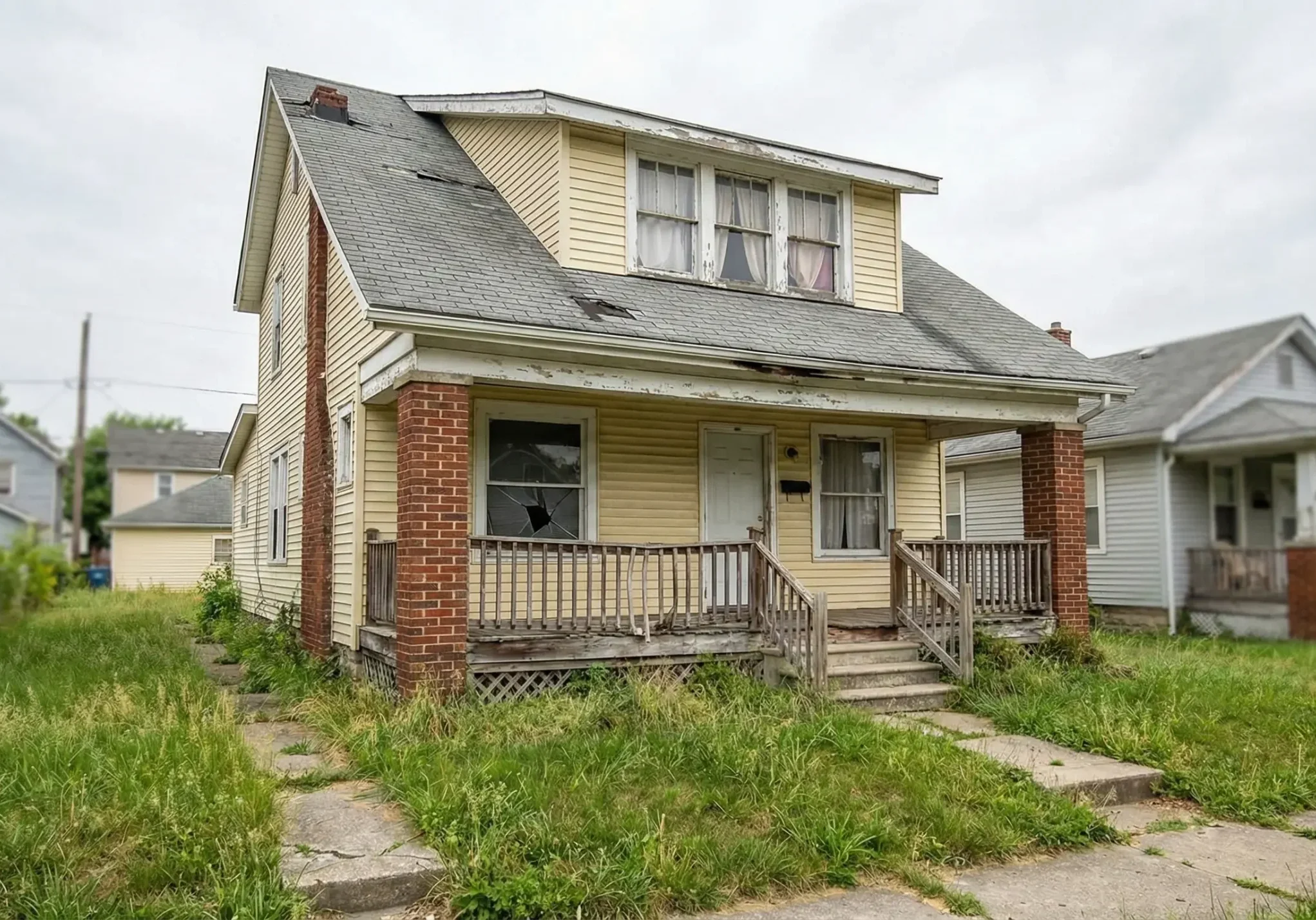
The difference: three months of uncertainty, repair costs, accumulating fines, and carrying costs versus two weeks to cash in hand.
Is a Cash Sale Right for Your Situation?
Selling a house in Columbus Ohio with code violations makes most sense when you're dealing with:
Understanding how cash home buyers work helps you negotiate effectively and set realistic expectations about offers.
The Numbers Behind Your Decision
Calculate the real cost of each option. A traditional sale at $250,000 minus $15,000 in repairs, $4,500 in holding costs, $13,500 in accumulated fines, $15,000 in commission, and $3,750 in closing costs nets you around $198,250—and that's if everything goes perfectly.
A cash offer at $205,000 with $2,000 in minimal holding costs (only 10 days) nets you $203,000. You close faster, avoid repair hassles, and stop the daily fine accumulation.
With 46 years of family experience in Columbus real estate, 250+ transactions, and an A+ BBB rating through EasySell Cash Homebuyers, I've helped sellers in every code violation scenario imaginable.
Cash Sale vs Traditional Sale for a House With Code Violations
If your house has code violations, a traditional sale can still work, but it often includes more steps: fixing violations to satisfy lenders, extended timelines while repairs are completed, inspection negotiations over who pays for what, and appraisal issues when comparable sales don't account for violation costs.
Cash buyers can be a better fit when violations are involved because they typically offer:
- No lender requirements to fix electrical, structural, or safety violations before closing
- No appraisal contingencies that could derail the deal when violations lower property value
- More certainty around the closing date since there's no financing to fall through
- A simpler process that doesn't require permits, inspections, or city sign-offs before transfer
The tradeoff is that a cash offer is often lower than a fully repaired retail listing because the buyer has to account for repair costs, permit fees, contractor coordination, and the time value of carrying the property through the renovation process.
But when you're facing $150-$250 in daily fines, can't afford $10,000-$50,000 in upfront repairs, or need to close before additional penalties accumulate, cash offers often net you more than waiting months for a traditional buyer who may walk away when their lender sees the violation notices.
Get Your Free Cash Offer Now!
Fill out this form to get your no-obligation all cash offer started!
Get Your Free Offer TODAY! (1)
Fill In This Form To Get Your No-Obligation All Cash Offer Started!

Can You Sell a House in Columbus Ohio With Code Violations?
Yes. You can sell a house in Columbus Ohio with code violations. The real question is whether you want to invest time and money fixing violations first, negotiate repairs with traditional buyers through credits and escrows, or sell as-is to eliminate the hassle entirely.
Once you understand Ohio's disclosure requirements and calculate the true cost of each path—including repair expenses, accumulating fines, carrying costs, and the risk of deals falling through—the right choice becomes clear for your specific situation.